Showing posts with label value. Show all posts

Friday, 18 October 2019

Day #35: The surprising ingredient that makes businesses work better

Today it's Friday, so there is time for a new video. Motivational, inspiring... or at least not too bad, I hope. 

The speaker, Marco Alverà, is a businessman and self-considered fairness crusader. He is also CEO of Snam, Europe's largest natural gas utility. His TED Talk is about unfairness, and how it does not only affect our personal lives, but also our business or our work. If there is a fairness culture along the culture, we will get happier employees and better results.


Happy weekend!

Friday, 11 October 2019

Day #30: As work gets more complex, 6 rules to simplify

I really like to start the weekend with inspirational videos, or short talks that make me think. Today, it is a TED Talk called As work gets more complex, 6 rules to simplify. I really like the starting point: we may feel disengaged at work because businesses are more dizzy and complex... and traditional management is obsolete. 

The speaker is Yves Morieux, a senior partner at BCG who calls his approach "smart simplicity" and encourages employees to cooperate to solve long-term problems. 


Happy weekend!

Monday, 16 September 2019

Day #11: BRM and PMI

In the entries posted last week, we were talking about benefits and value in general and Benefits Realization Management (BRM) in particular. Today I would like to talk a bit more about the context of BRM in the PMI, because one of the reasons why some terms become popular is because the PMI invests time and resources in developing a new area of knowledge. 

In this case, Benefits Realization Management or Benefits Management is one of the new ares included in the PMP Exam from January 2016. Prior to that, extensive research was conducted for 2 years, since this is a relatively new discipline not very well understood in many organizations. The idea was to find a correlation between benefits realization maturity on an organization and the success of projects and programs. 

They have also published three Pulse of the Profession reports covering BRM in depth. Besides, they have created some videos like the one shown here to rise the interest in this area.

So, you see, BRM is relatively new, yet it has a great potential. Let's dig more into the framework in following posts!


Information taken from What us Benefits Realization Management (BRM)?

Friday, 13 September 2019

Day #10: Why is Benefit Management so hard to do?

One of the most difficult things of this recently discovered (for me!) world of PM, is the fact that everything is a bit abstract. Maybe it is because my background is engineering, and I need not only information but also real-life examples and application procedures. 

But it seems that I'm not the only one who is afraid of abstraction and who finds difficult to include all the theoretical concepts in the routine. The article Why is Benefit Management so hard to do? goes directly into the core of the problem and it is an interesting reading. It follows yesterday's approach, when I wrote about research regarding how project managers were not as involved as they could in BRM.

So now we have a poll directed to PM with the opening question of this post and here are the answers:

fernandjune61
From the original article Why is Benefits Management so hard to do? , projecttimes.com

Fernando Santiago, with over 25 years of PM experience, comments on those answers and uses other PM's testimonies, making the article packed with interesting insights.

But I found interesting that the first and third most popular options, which together represent more than 50%, are about what we discussed yesterday: there is a lack of governance and accountability. Project managers are aware of the importance of benefits management, yet they aren't good at it because they think that it is not in their role. They only think about outcomes, not necessarily about benefits.

This is more technically referred as being focused on the "triple constraint" of PM (more to come in future posts). The term and the idea appeared in yesterday's publication as well, but here it is very well summarized in words of Calum Robertson, Principal Portfolio Analyst at Auckland Council: "Change in culture from thinking about projectts to thinking about investments. Projects are expected to be completed 'on time, on budget', but investments are expected to yield a return". 

I guess the key concept of the week is that BRM is important, their enablers such as adequate governance or tracking are crucial (remember the Bridge to Nowhere!) and PM should be fully involved, even when it implies a small twist in their mindset. 

Wednesday, 11 September 2019

Day #8: Bridge to Nowhere

One of the most important aspects in Benefit Realization Management (BRM) is to have metrics that allow to track and monitor the benefits. I guess you all can think about projects that didn't have right metrics, usually those where you think: "Wow, did they really think about this?". The first ones that come to my mind are related to underused airports in areas in Spain with very low population rates. Spain has more airports than Germany (59 vs 50), even when our population is just half.

Anyway, my intention wasn't to complain about airports but to mention an example of poor BRM that I have found and which apparently is very famous: the Bridge to Nowhere. 

Let me explain the basic information. Its real name is the Gravina Island Bridge, since it was intended to connect the city of Ketchikan (Alaska 9000 inhabitants) with Gravina Island, where 50 people live. and an international airport is located (seriously, this post isn't about airports). The original transport between those points was made by a ferry service, yet some Ketchikan residents complained about the waiting time and the car fee. That's the reason why a project was proposed in 2008, with challenging technical specifications. A bridge taller than the Brooklyn Bridge and as long as the Golden Gate was about to be built, with an estimated cost of $398 million.
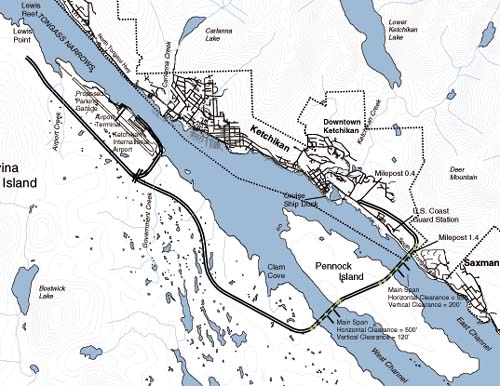
Resultado de imagen de bridge to nowhere gravina island
Ketchikan and Gravina Island map. from taxpayer.net

The project was backed by an Alaska congressman and senator, who were seeking for government resources and support. The bridge was never built, yet it was considered for several years, before it was cancelled in 2015. The decision was to invest a tiny part of the huge bridge budget in improving the existing ferry service. Happy ending, isn't it?

The project was a clear example of mismanagement of public resources and wasteful government spending. But also, from our BRM perspective, it is clear that the cost-benefit (value!) analysis was never performed, or taken into consideration. For organizations, the outcomes of a project should turn into benefits, and those into value. Here, the saddest part is that several years were needed until basic evaluation and corrective action (Stop the bridge!) were taken. 

So, you know, if you plan to travel to Ketchikan soon, remember that (fortunately!) you will have to take a boat.

Sources:

Tuesday, 10 September 2019

Day #7: Adding value to your company

Value is a very polysemic word. Companies have core values, products have some value... and employees can add value. Actually, that is one of the most common questions asked in work interviews: "Why should we hire you?", "What can you bring to the company?". 

Resultado de imagen de job interview
Picture from forbes.com

The most valuable asset for companies are the employees. Businesses succeed because companies try to find, hire and keep the best person for a certain role: someone talented which will add value to the organization. 

Sometimes you have an answer ready for the "value-question" in the job interview, but once you start working it is difficult to find your own way to create and add value, especially if your tasks are boring or repetitive, or even worse, they are not very clear. However, there are always ways: showing initiative, being good at teamwork or keeping your skills up to date. 

One can read that this "adding-value-stuff" is about collecting merits for career advancement or promotion, but I believe that it is much more important than that. It is about feeling that you are doing your best and you have a sense of commitment with a project, your work in this case. 

Anyway, for further reading about this topic:


How to Add Value to Your Company & Contribute to Your Team
5 Reasons Why (and How) to Add Value to Your Employer
Fifteen Ways to Show Your Value at Work

Monday, 9 September 2019

Day #6: The business benefits of doing good

I have run into this Ted Talk, given by Wendy Woods, a social impact strategist, Senior Partner of The Boston Consulting Group (BCG). The title is very enlightening: The business benefits of doing good.

In the talk, Wendy explains how the idea of Total Societal Impact (TSI) has gone way beyond the Corporate Social Responsibility (CSR). The idea is that business work, done with innovation, can actually create core business benefits for companies and solve meaningful problems in the world today. As a result, TSI must be combined with TSR (Total Shareholder Returns) as important drivers of corporate strategy and decision-making. 

Then, she shows some data and gives some examples about how the value and margins of companies which actively care about TSI increase, like banks, pharmaceutical or coffee suppliers. 

I think it is a very interesting topic, since it gives a new dimension to the idea of benefits. One could think that doing good is not the most profitable activity, but this TED Talk shows the opposite. Besides, Wendy is right when suggesting that NGOs and charities are not enough to solve the most crucial problems in the world. Companies and investors are needed, and if their presence creates tangible economic benefits, then we will be sure that they won't leave. 

Image result for wendy woods ted talks
Wendy Woods at the TED Talk. Image from ted.com