Showing posts with label social impact. Show all posts

Wednesday, 30 October 2019

Day #43: Gender Pay Gap

We are almost at the end of the blog... so it's time to bring up again an important subject: the gender pay gap. To do so, we will use an article from the Financial Times which uses data for masters in management rankings over the past decade, for alumni three years after graduation. Some facts illustrated with figures:


  • Three years after graduating with a masters in management, the median salary for men is higher than for women in every sector of employment. Healthcare and finance have the greatest gender pay gap.
  • When the pay of men and women is compared by seniority, women are ahead only in mid-level management positions.
  • Finance and consultancy have always been the top destinations of Masters in Management graduates. Together, they represent 45-50% of the alumni.
  • Law, finance and consultancy are the sectors with the highest salaries.
  • Most alumni who moved to a different country after graduating in MiM see a rise in salary, specially in healthcare. Law is the only sector where movers see a lower mean salary.
A graphic with no description
Image from ft.com

Friday, 18 October 2019

Day #35: The surprising ingredient that makes businesses work better

Today it's Friday, so there is time for a new video. Motivational, inspiring... or at least not too bad, I hope. 

The speaker, Marco Alverà, is a businessman and self-considered fairness crusader. He is also CEO of Snam, Europe's largest natural gas utility. His TED Talk is about unfairness, and how it does not only affect our personal lives, but also our business or our work. If there is a fairness culture along the culture, we will get happier employees and better results.


Happy weekend!

Monday, 7 October 2019

Day #26: Portofolio Management and Japanese renewable energy

As we have mentioned many times, the PMI is not only the main association in the PM world, but also a very useful source to keep ourselves informed. 

In particular, there are interesting news regarding portfolio management. For example this piece of news, Sustainable Change, which talks about how the Japanese energy industry changed after Fukushima. The author, Rajeev Supekar, has managed renewable energy projects in Japan for years. He explains the factors that helped a whole country to embrace the disruption and use it to make a transition towards renewable energies. 

Now that energy and climate are in the centre of all discourses, it can be a good idea to take Japan as an example. Besides, articles like this can help us understand the transversality of portfolio management. 


Resultado de imagen de renewable energy
Image from nrdc.org

Note that many articles from PMI can be accessed just by creating a free account at PMI website, without getting a full membership!

Tuesday, 24 September 2019

Day #17: Women & Project Management

Today's post is a bit off-topic, since it doesn't focus on Portfolio Management but on Women in PM. I found a combined interview in Project Management Today to Manon Bradley, Sarah Colemna and Teri Okoro, all of them highly experienced project managers. It may be a bit old, before the #MeToo movement, yet the content is still very interesting and makes us think about the role of women in PM, what is happening now and what comes next. 

Resultado de imagen de women in tech
Picture from fifteendesign.co.uk

Besides, it is not only about how many women work in project management roles or how to achieve a better equality, but it includes the figures from a report about Diversity and Retention. The numbers are quite striking:

  • Just 28% of surveyed project managers said they are happy in their current jobs. 
  • 67% of project managers are actively looking for a new job. 
  • 55% of project managers seeking a new position report that “finding opportunities that align with their skills and experience” is their greatest challenge. 
  • 46% of those seeking new posts believe that the “remuneration levels on offer are too low”. 
  • 75% of working projects managers have not received a pay rise above the rate of inflation this year (93% of project managers working in the public sector). 
  • 74% of private sector respondents anticipate some level of growth in their current organisation during 2014. 
  • 55% of respondent involved in recruiting programme and project managers in 2014 reported that filling roles has been difficult due to a lack of suitable applicants and restrictions on available remuneration.

These results are from 2014, yet they look a bit discouraging. It's one more reason to focus on the education to be a good project manager, and try to get the most out of one's skills. As one of the interviewees says, "There’s a lot more awareness and recognition around project management as a skill and a function and how it can help to move organisations towards where they want to go. It’s no longer just about construction and heavy industry."


Thursday, 19 September 2019

Day #14: BRM, ORBIT and Thai cows

I'm bringing to stage today another example of implementation or framework realization of BRM, in this case applied to the dairy mil industry in Thailand. The reason behind using BRM techniques to challenging projects is always the same: it is not enough to measure projects in terms of, for example, successful deployment, yet in terms of gained benefit of having such project working. 

In this paper, ICT benefit realization for dairy farm management: Challenges and future direction, the field is the dairy milk industry in Thailand, which has a very limited database system to satisfy the needs of the authorities. However, a more advanced ICT project would help to transform basic information records into a disease prevention control program, for example, or have an impact in decisions related to feeding or mating. 

The authors propose an "ICT Benefit Realization Framework designed for non-IT users" under the name of ORBIT: Operation of Realizing Benefit in Information Technology. It includes milestones, activities and stakeholders involved in four phases: planning, realization, exploration and evaluation. The first phase, planning, is applied and the results explained, leaving farmers and other people involved ready to start the realization phase. 

The paper is easy to follow, well structured and full of nice and instructive images. Besides, it takes us closer to a new world... no, not BRM, but Thai dairy industry!

Image result for cow
Cow from en.wikipedia.org

Wednesday, 11 September 2019

Day #8: Bridge to Nowhere

One of the most important aspects in Benefit Realization Management (BRM) is to have metrics that allow to track and monitor the benefits. I guess you all can think about projects that didn't have right metrics, usually those where you think: "Wow, did they really think about this?". The first ones that come to my mind are related to underused airports in areas in Spain with very low population rates. Spain has more airports than Germany (59 vs 50), even when our population is just half.

Anyway, my intention wasn't to complain about airports but to mention an example of poor BRM that I have found and which apparently is very famous: the Bridge to Nowhere. 

Let me explain the basic information. Its real name is the Gravina Island Bridge, since it was intended to connect the city of Ketchikan (Alaska 9000 inhabitants) with Gravina Island, where 50 people live. and an international airport is located (seriously, this post isn't about airports). The original transport between those points was made by a ferry service, yet some Ketchikan residents complained about the waiting time and the car fee. That's the reason why a project was proposed in 2008, with challenging technical specifications. A bridge taller than the Brooklyn Bridge and as long as the Golden Gate was about to be built, with an estimated cost of $398 million.
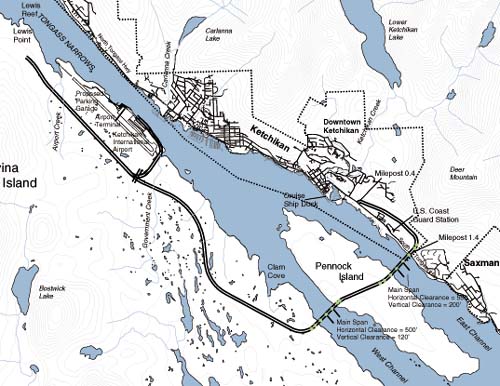
Resultado de imagen de bridge to nowhere gravina island
Ketchikan and Gravina Island map. from taxpayer.net

The project was backed by an Alaska congressman and senator, who were seeking for government resources and support. The bridge was never built, yet it was considered for several years, before it was cancelled in 2015. The decision was to invest a tiny part of the huge bridge budget in improving the existing ferry service. Happy ending, isn't it?

The project was a clear example of mismanagement of public resources and wasteful government spending. But also, from our BRM perspective, it is clear that the cost-benefit (value!) analysis was never performed, or taken into consideration. For organizations, the outcomes of a project should turn into benefits, and those into value. Here, the saddest part is that several years were needed until basic evaluation and corrective action (Stop the bridge!) were taken. 

So, you know, if you plan to travel to Ketchikan soon, remember that (fortunately!) you will have to take a boat.

Sources:

Monday, 9 September 2019

Day #6: The business benefits of doing good

I have run into this Ted Talk, given by Wendy Woods, a social impact strategist, Senior Partner of The Boston Consulting Group (BCG). The title is very enlightening: The business benefits of doing good.

In the talk, Wendy explains how the idea of Total Societal Impact (TSI) has gone way beyond the Corporate Social Responsibility (CSR). The idea is that business work, done with innovation, can actually create core business benefits for companies and solve meaningful problems in the world today. As a result, TSI must be combined with TSR (Total Shareholder Returns) as important drivers of corporate strategy and decision-making. 

Then, she shows some data and gives some examples about how the value and margins of companies which actively care about TSI increase, like banks, pharmaceutical or coffee suppliers. 

I think it is a very interesting topic, since it gives a new dimension to the idea of benefits. One could think that doing good is not the most profitable activity, but this TED Talk shows the opposite. Besides, Wendy is right when suggesting that NGOs and charities are not enough to solve the most crucial problems in the world. Companies and investors are needed, and if their presence creates tangible economic benefits, then we will be sure that they won't leave. 

Image result for wendy woods ted talks
Wendy Woods at the TED Talk. Image from ted.com